
Markets do not have emotions, party affiliations, nor any loyalties. They do, however, have prices, expectations, and a relentless tendency to discount the future. That's the most useful starting point for assessing any claim that a surge in record highs proves something definitive about political leadership. Now we know that politicians are going to politick (even if they're not politicians. Their team is still going to look for a way to attribute positives to the policies of the administration, sometimes legitimately.
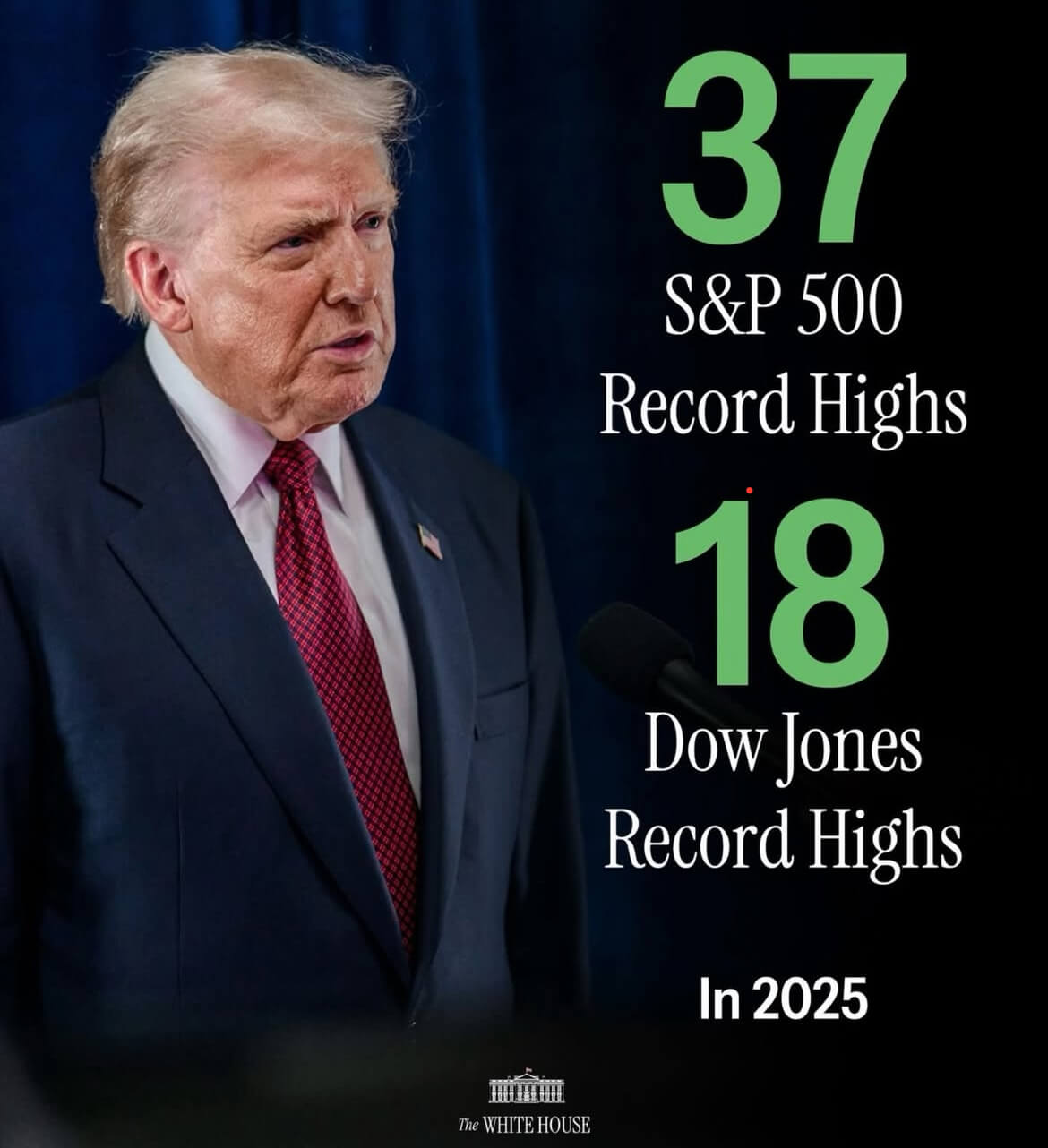
The graphic circulating with the assertion of 37 S&P 500 record highs and 18 Dow Jones Industrial Average record highs “in 2025” attempts to compress a complex system into a scoreboard. A sober evaluation does't require hostility, adoration, and especially not any reflexive cynicism. It requires a disciplined separation between what record highs actually measure, what they do not measure, what drives them mechanically, and what can reasonably be attributed to presidential influence versus broader macroeconomic forces.
A record high is a precise concept with a narrow scope. It simply means an index closed at a level higher than any prior close in nominal terms. That's all. It does not automatically mean the economy is healthier in a broad-based way, that household finances are improving, or that the purchasing power of wages is rising. A nominal index can hit new highs during inflationary periods even when “real” progress is more modest. The milestone is real and the market value is real, but the inference people draw from it often exceeds the data. Financial markets are powerful signalers, but they aren't a single-variable referendum on national well-being.
The reason record highs can cluster is straightforward. Equity indices are forward-looking, and they reflect a constantly updated estimate of future corporate earnings and the discount rate investors apply to those earnings. When expected earnings rise, or when the discount rate falls, or when risk appetite increases, prices move higher. When multiple supportive forces align at once, the index does not simply rise; it can repeatedly push through previous ceilings, producing a run of record highs in short order. This is not rare. It is a normal feature of long-term equity markets, especially in periods of strong liquidity, technological shifts, and concentration into perceived “winners.”
Inflation plays a crucial role in how record highs should be interpreted. In an environment where the general price level is rising or where inflation has recently been elevated, nominal assets often rise because the currency unit itself is worth less over time. Even if companies are only maintaining real profitability, their nominal revenues and earnings can rise as prices rise. Investors see those higher nominal earnings and may bid up equities, particularly if they believe companies have pricing power. In this context, record highs can occur more frequently without necessarily implying that living standards are improving at the same pace. A market can make new nominal highs while households still feel financially squeezed, especially if wage growth lags cost-of-living increases or if housing and insurance costs accelerate faster than income.
Index construction also matters more than most people realize. The S&P 500 is market-cap weighted, which means the largest companies exert disproportionate influence on the index level. When mega-cap firms experience strong earnings, expanding margins, or a valuation re-rating, the entire index can surge even if many mid-sized or smaller companies are flat. The Dow is price-weighted, which introduces a different distortion: higher-priced stocks influence the index more than lower-priced stocks, regardless of company size. In practice, both indices can rise sharply because leadership is concentrated in a subset of names, sectors, or themes. This is why investors should be cautious about equating index-level records with “the average company” or “the average worker.” The index is a composite; it is not a census.
Record highs also often reflect capital’s preference for perceived safety and quality during uncertain times. When the global environment is unstable, capital tends to flow into deep, liquid markets and well-known firms with strong balance sheets. U.S. equities, particularly the largest companies, can benefit from that reflexive “flight to quality,” even if the underlying economy is experiencing mixed signals. In other words, a rising index may be partially about the United States being the most attractive option among imperfect alternatives, not necessarily about uniform domestic prosperity.
This context doesn't invalidate the idea that policy and leadership influence markets though. It just clarifies how influence should be framed. A U.S. president does not control daily market fluctuations. No president sets quarterly earnings. No president commands global capital flows. Nor does any U.S. president directly control the Federal Reserve’s decisions under the formal structure of U.S. monetary governance. The market’s day-to-day movement is an emergent outcome of millions of decisions, domestic and international, driven by interest rates, earnings, risk sentiment, and expectations about growth. It is a mistake to assign every uptick to the Oval Office, and it is equally a mistake to pretend the Oval Office is irrelevant.
Presidential influence is best understood through the channels that shape business conditions and expectations. Regulatory posture affects the cost of doing business, particularly in finance, energy, healthcare, and industrial production. Tax policy influences after-tax earnings, the attractiveness of capital investment, and the incentives for repatriation, dividends, and buybacks. Energy policy affects input costs across the entire economy, especially for logistics, manufacturing, chemicals, and agriculture. Trade posture influences supply chains, tariff risks, and domestic industrial strategy. Even when policy changes have not yet taken full legal effect, the market can reprice based on credible expectations. Markets do not wait for the ink to dry; they attempt to discount the future as soon as probabilities shift.
That is why “policy signaling” matters. If investors believe a new administration will pursue lower regulatory friction, a more predictable compliance climate, or stronger support for domestic production and energy abundance, the market may re-rate upward before measurable economic outcomes arrive. This is not ideology; it is the mechanism of discounting. Expectations can create immediate price movement because prices are not a backward-looking summary of what has happened. They are a present-value estimate of what may happen.
Still, expectations are not guarantees. Markets can price in favorable outcomes that never materialize, just as they can underprice opportunities that later prove substantial. A run of record highs can be a rational response to real improvements, a rational response to probabilities shifting, an irrational overshoot driven by exuberance, or some mixture of all three. The correct posture is disciplined humility: acknowledge what the market is signaling while refusing to treat that signal as a complete diagnosis of national economic health.
The Dow and the S&P 500, taken together, provide a useful nuance. Because the two indices are constructed differently and carry different sector weights, record highs in both can suggest breadth of optimism across multiple corporate categories. It implies the market is not purely being lifted by a narrow cohort of high-growth technology firms; it may also reflect strength or expectations of strength in industrials, financials, and other legacy components. That said, the modern U.S. equity market can still be highly concentrated even when both indices are rising, so breadth should be tested with internal market measures, sector participation, and equal-weight indices before concluding that the rally is broadly distributed.
That said, it’s also reasonable to acknowledge that the improving economic backdrop over the past year has not occurred in a vacuum. Market optimism has been reinforced by clear policy signals from the Trump Administration favoring lower regulatory friction, a more permissive energy posture, corporate tax stability, and a renewed emphasis on domestic production and capital formation. Commitments to expand U.S. energy supply have helped ease input-cost expectations across transportation, manufacturing, and agriculture.
A restrained approach to new regulation has reduced compliance uncertainty for large employers and financial markets. Continued support for investment-friendly tax treatment and a more assertive trade stance aimed at rebalancing supply chains toward U.S. industry have further strengthened forward earnings expectations. Markets don’t assign credit ceremonially, but they do respond decisively to conditions that favor profitability, predictability, and growth—and those conditions are increasingly reflected in current pricing behavior.
A serious investor or analyst should treat a run of record highs as an invitation to ask better questions rather than to declare victory. Which sectors are driving the highs, and are they tied to sustainable earnings growth or multiple expansion? How much of the move is explained by changes in the risk-free rate and expected inflation? Is the rally broad across companies, or concentrated in a small number of names? Are real wages and productivity keeping pace with asset appreciation, or is the economy bifurcating into asset owners versus everyone else? Are deficits, debt servicing costs, and monetary conditions creating hidden fragilities that markets may be underpricing? These questions are where clarity begins, and they're the difference between analysis and slogan.
In the end, the market is a forecasting machine with imperfect accuracy, not a moral authority and certainly not a partisan instrument. A graphic that tallies record highs can be a true statement about index closes and still be incomplete as economic interpretation. The value of disciplined analysis is that it can acknowledge strong market performance, recognize plausible policy-related contributions through expectations and business conditions, and still refuse to confuse nominal index milestones with comprehensive national prosperity. That's the sober ground between denial and propaganda, and it's the ground that serious economic thinking requires.